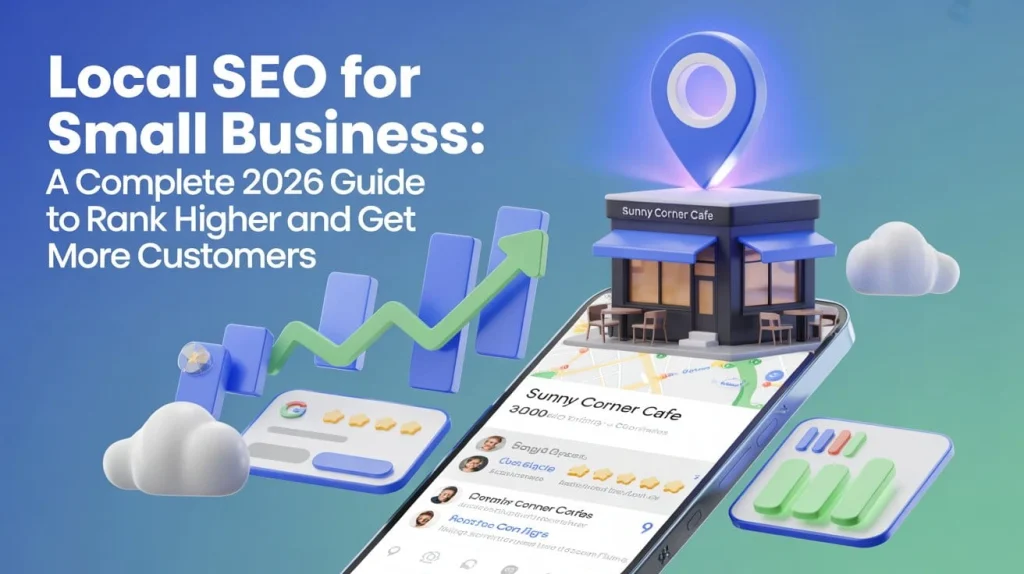

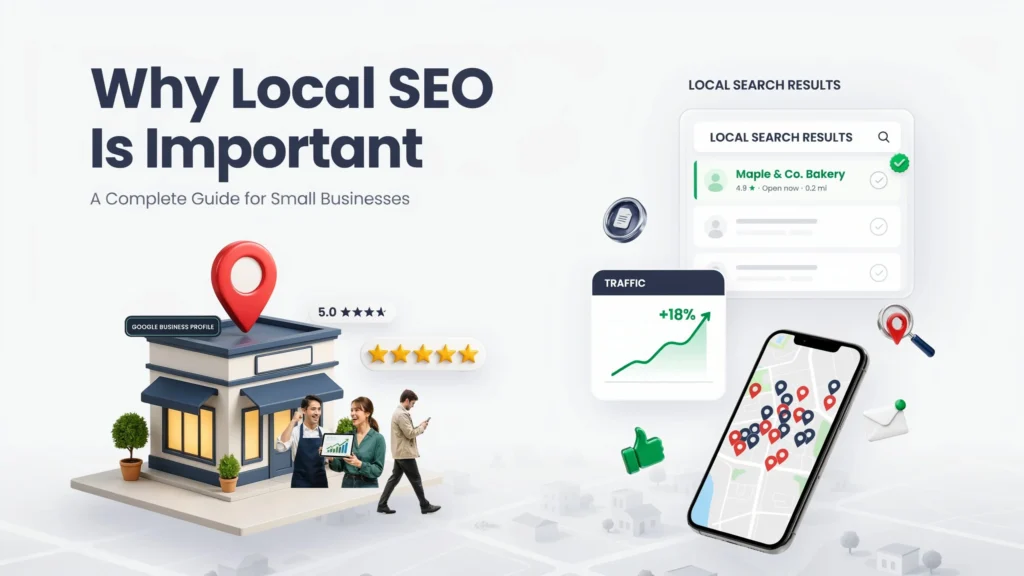
Imagine walking down the main street of your town. You pass by a boutique clothing shop, a bustling local cafe, and a family-owned hardware store that has been there for decades.
For generations, these businesses thrived on physical foot traffic, word-of-mouth recommendations, and maybe a catchy ad in the local newspaper. But today, the physical main street has a digital twin.
For a small business owner, this shift can feel incredibly daunting. It often feels like you are swimming in a massive online ocean where giant, multi-billion-dollar corporations hold all the power and command all the attention.
But here is the good news: when it comes to winning customers right in your own backyard, you actually have a massive secret weapon. It’s called local search.
If you have ever wondered how to get nearby customers through your doors without burning through a massive corporate marketing budget, you need to dive into Local SEO Explained.
Let’s pull back the curtain on why local seo is important, explore how the digital landscape really works, and look at how you can leverage these strategies to dominate your local market.
Table of Contents
What Is Local SEO?
Before we look at the specific benefits and strategies, let’s establish a foundational Understanding Local SEO.
To put it in the simplest terms possible, What Is Local SEO? Think of traditional search engine optimization (SEO) as a global megaphone. It is designed to help a website rank for keywords regardless of where the searcher is located.
Local SEO, however, is a hyper-targeted laser beam. It is specifically designed for businesses that serve a physical, geographic community.
If you run a neighborhood bakery, you don’t really care if someone in Tokyo finds your website. You want the person standing three blocks away who is currently typing “fresh sourdough near me” into their phone to find you.
If you operate a brick-and-mortar storefront or serve a specific geographic region, mastering these Local SEO Fundamentals is what prevents your business from becoming completely invisible online.
How Local SEO Works: Behind the Scenes of Google’s Brain
To make this strategy work for your business, it helps to understand how Local SEO works behind the scenes.
Search engines have a monumental task: they have to sort through billions of data points to give a user exactly what they want in a fraction of a second.
1. Relevance
Relevance is all about how well your business matches what the user is actually looking for. If someone searches for “vegan gluten-free pizza,” Google isn’t just going to look for generic pizza parlors.
It is going to crawl websites, review platforms, and business profiles to find the specific places that explicitly mention vegan and gluten-free options.
2. Distance
Distance is exactly what it sounds like: how far your business is located from the searcher (based on their phone’s GPS or desktop IP address) or from the specific location name they typed into the search bar.
Google wants to provide the most convenient options possible, which means a highly relevant business that is two blocks away will often outrank a business that is five miles away.
3. Prominence
Prominence is essentially a measure of your business’s reputation and credibility in the offline and online world.
Google wants to send its users to businesses that are trusted, well-liked, and established. How does it measure this?
It looks at your review scores, the volume of reviews you receive, how often your business is mentioned across the web, and how many high-quality local websites link back to yours.
The Biggest Local SEO Benefits for Small Businesses
Now that you know what it is and how it functions, let’s talk about the actual return on investment. Why should you invest your limited time, energy, and budget into this strategy?
The Local SEO Benefits speak for themselves, offering small businesses a level of leverage that traditional advertising simply cannot match.
Local search turns this dynamic entirely on its head. Instead of chasing down cold leads, you are positioning your business to be found by high-intent users at the exact moment they need your help.
Capturing High-Intent Traffic
Think about the psychology of a local search. When someone opens their phone and searches for “locksmith open now” or “brake repair shop,” they aren’t just browsing for fun.
They aren’t doing casual academic research. They have an immediate, pressing need, and they have their credit card in hand.
Local search allows you to position your business directly in front of consumers at the exact moment they are ready to make a purchase.
Leveling the Playing Field
In the world of standard organic search, it is incredibly difficult for a local independent shoe store to outrank a massive corporation like Amazon or Nike for a broad keyword like “running shoes.” Those giants have millions of dollars to spend on SEO.
However, when a user searches for “running shoes downtown Austin,” the algorithm shifts. Google intentionally suppresses the global giants to make room for local businesses.
This allows Local SEO for Local Companies to compete directly with massive national brands, giving you a fair shot at winning the customer.
Boosting Foot Traffic and Phone Calls
A well-optimized local presence acts as a direct funnel to your physical storefront or phone line.
When your business shows up clearly on a map with a one-click “Directions” button or a “Call Now” button, you eliminate all friction between the customer discovering you and the customer interacting with you.
Incredibly Cost-Effective Marketing
Traditional marketing channels—like billboards, local TV spots, radio ads, or direct mail flyers—can cost thousands of dollars and often reach people who have absolutely no interest in your services.
Furthermore, the second you stop paying for those ads, the traffic completely vanishes. Local search optimization, on the other hand, offers compounding, long-term organic visibility.
Once you build a strong local foundation, it continues to bring in customers month after month without an ongoing pay-per-click cost.
Mastering the Local Pack and Google Maps
If you want to understand where the real magic happens in local search, you need to look at the Local Pack.
Whenever you perform a search with local intent, Google doesn’t just show you a standard list of blue website links.
Instead, it places a highly prominent box right at the top of the page. This box contains a map of the local area, followed by three specific business listings. This is the Holy Grail of local real estate.
Winning a spot in those top three positions requires a dedicated commitment to Google Maps SEO.
Because the vast majority of mobile clicks go directly to these three listings, achieving high Local Pack Rankings and boosting your Google Maps Rankings should be the ultimate goal of your campaign. To get there, you must master two critical components.
1. Google Business Profile Optimization
Your Google Business Profile (which used to be called Google My Business) is the absolute heart and soul of your entire local strategy.
It is a free tool provided by Google, but many small businesses treat it like a static directory listing—they fill out the bare minimum and forget about it.
True Google Business Profile Optimization is a continuous process. To signal to Google that your business is active and reliable, you need to:
- Claim and verify your ownership of the profile.
- Ensure your business name matches your legal name exactly (avoid stuffing it with spammy keywords).
- Select the precise primary and secondary business categories that fit what you do.
- Upload high-resolution, real photos of your team, your storefront, and your work.
- Keep your operating hours updated in real-time, especially during holidays.
- Regularly post updates, offers, and events directly to your profile.
- Proactively respond to every single customer review—both the enthusiastic five-star praises and the occasional, difficult negative critiques.
2. NAP Consistency and Local Citations
To rank you highly on maps, Google’s algorithm needs to feel 100% confident that your business actually exists where you say it does and that your contact information is correct.
If Google encounters conflicting information across the web, it gets confused. And a confused algorithm will never rank you on the first page.
This is where %NAP Consistency comes into play. NAP stands for Name, Address, and Phone number.
You must ensure that these three core pieces of data are formatted identically everywhere they appear online—from your own website to social media platforms, local Chamber of Commerce pages, and directory sites like Yelp, YellowPages, and Tripadvisor.
Every time your business is mentioned on one of these third-party websites, it is called a Local Citation.
Think of these citations as digital votes of confidence. The more consistent, high-quality citations you have across reputable web directories, the more legitimate your business looks to Google’s ranking crawlers
Tailoring Local Strategies for Different Business Models
One of the biggest misconceptions about local search is that it only applies to retail storefronts or restaurants. In reality, different business models require distinct, tailored approaches.
If you choose to partner with an agency for professional Local SEO Services, they will generally customize your strategy based on how you interact with your clients. Let’s break down how local search adapts to different business frameworks:
Local SEO for Service Businesses
What if you are a plumber, an electrician, a pest control specialist, or a mobile pet groomer? You don’t have a storefront where customers come to sit down and buy things.
Instead, you operate from a home office or dispatch warehouse and travel to your customers. Local SEO for Service Businesses requires a unique approach.
Instead of highlighting a specific street address that might just be your home, you configure your Google Business Profile as a “Service Area Business.” This allows you to define the exact ZIP codes, counties, or radii that you serve.
The strategy focuses on creating location-specific content and optimising your online presence so that when prospective students search for “study abroad consultants near me,” your business ranks prominently in local search results and attracts qualified leads.
Local SEO for Multi-Location Businesses
If your brand has grown beyond a single shop and now operates out of three, five, or fifty different locations, a single, centralized approach simply will not work.
Each branch is competing in a totally different micro-market with its own unique set of local competitors.
Managing Local SEO for Multi-Location Businesses requires a highly organized, scalable blueprint. You must create separate, dedicated landing pages on your primary website for every single location.
Each location page needs its own unique, localized content, its own embedded map, and its own distinct NAP data. Furthermore, you must manage and optimize a separate Google Business Profile for each branch to ensure each achieves visibility in its local community.
Your Local SEO Roadmap to Success
To make this journey practical and highly actionable, let’s break down your implementation plan into four foundational steps:
- Step 1: Audit Your Foundation. Run a comprehensive check on your current NAP data across the web. Hunt down any duplicate profiles, outdated phone numbers, or misspelled addresses and correct them immediately.
- Step 2: Claim Your Digital Real Estate. Claim your official Google Business Profile. Take the time to fill out 100% of the profile details, leaving no section blank or incomplete.
- Step 3: Build a Review Engine. Create a routine process where your team asks every happy customer for feedback. Make sure you reply to all incoming reviews promptly and professionally.
- Step 4: Localize Your Website. Embed a clean Google Map on your contact page, and weave reference points to local landmarks and surrounding neighborhoods naturally into your website copy.
Taking Your First Steps
If you are currently looking at your business’s digital presence and feeling overwhelmed, take a deep breath. You do not have to optimize everything overnight. Think of this guide as your practical Beginner’s Guide to Local SEO.
The digital main street isn’t going anywhere, and the businesses that choose to claim their space on it today are the ones that will thrive tomorrow.
Understanding and implementing Local Search Engine Optimization isn’t just a trendy marketing luxury anymore—it is a core survival requirement for modern small businesses.
By taking the time to optimize for local search today, you ensure that the next time a neighbor looks for exactly what you offer, they don’t find your competitor down the road.
They find you.
What is Local SEO?
Local SEO is the process of optimizing your online presence to attract customers from local search results and Google Maps.
Why is Local SEO important for small businesses?
Local SEO helps small businesses increase visibility, attract nearby customers, and generate more calls, visits, and sales.
How does Google determine local search rankings?
Google uses relevance, distance, and prominence to rank businesses in local search results.
What is a Google Business Profile?
A Google Business Profile is a free listing that helps businesses appear in Google Search and Google Maps.
How long does Local SEO take to show results?
Most businesses start seeing noticeable improvements within 3–6 months, depending on competition and optimization efforts.
Can Local SEO help service-area businesses?
Yes, Local SEO is highly effective for service-area businesses such as plumbers, electricians, and cleaners.
Is Local SEO better than paid advertising?
Local SEO provides long-term organic visibility, while paid ads generate traffic only while you continue spending money.
What are the main benefits of Local SEO?
The main benefits include higher local rankings, increased website traffic, more customer inquiries, and improved brand trust.