
Most agency owners start with one simple goal — get more clients.
But after a few wins, a different problem shows up.
Delivery.
More clients mean more work. More work means more pressure. Suddenly, growth starts to feel like a burden instead of progress.
You either:
- Hire more people and increase costs
- Compromise on quality
- Or stop scaling altogether
This is the point where most agencies get stuck.
White label digital marketing solves this exact problem — not by adding more complexity, but by simplifying how work gets done behind the scenes.
If you already understand the fundamentals, this model becomes extremely powerful. If not, it’s better to revisit the system first through this digital marketing guide so everything connects clearly.
Table of Contents
What is White Label Digital Marketing
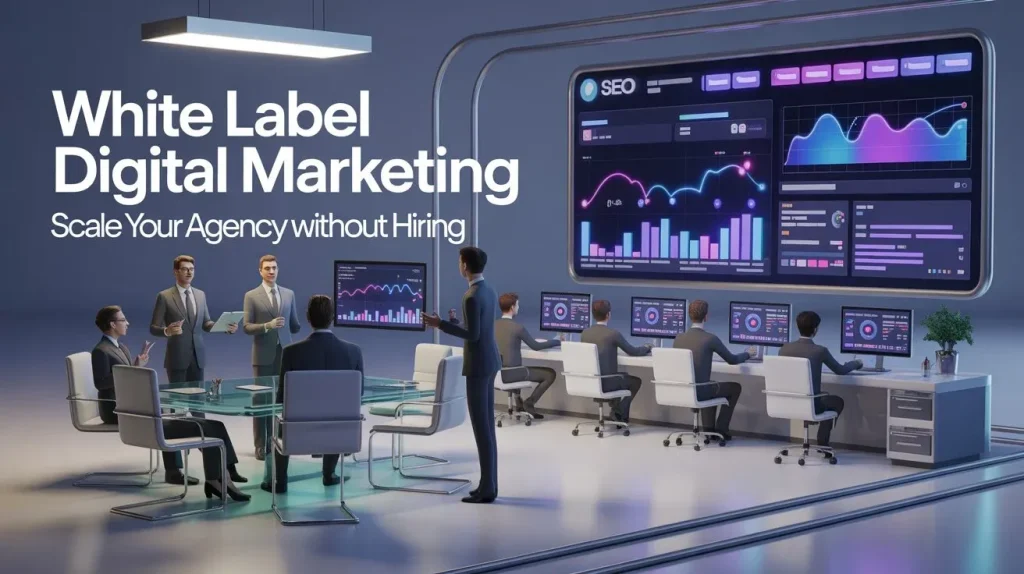
White label digital marketing is a business model where an agency outsources services to a third-party provider who delivers the work under the agency’s brand name.
In simple terms:
- You sell the service
- Someone else fulfills it
- The client sees only your brand
This allows agencies to scale without hiring or managing large teams.
Why White Label is Growing Fast
The demand for digital services is increasing, but building in-house teams is becoming harder.
Agencies are facing:
- High hiring costs
- Talent shortages
- Inconsistent delivery
- Operational complexity
White label solves all of these by separating sales from fulfillment.
You focus on growth.
They handle execution.
How White Label Digital Marketing Actually Works
Most people understand the concept but not the workflow.
Real Process
| Step | Action |
| 1 | You close the client |
| 2 | You define scope |
| 3 | You assign work to provider |
| 4 | Provider completes under your brand |
| 5 | You deliver results to client |
The client never interacts with the backend provider.
What Services Can Be White Labeled
Almost everything in digital marketing can be outsourced.
Core Services
| Service | Outcome |
| SEO | Organic traffic growth |
| PPC Ads | Lead generation |
| Content Writing | Authority building |
| Web Development | Conversion improvement |
| Social Media | Brand visibility |
White Label SEO
SEO is the most commonly outsourced service.
Because it requires:
- Continuous effort
- Technical expertise
- Data-driven decisions
Most agencies prefer not to build full SEO teams.
To understand how data drives SEO success, see digital marketing analytics.
White Label vs In-House (Honest Comparison)
This decision defines your growth path.
Comparison
| Factor | In-House | White Label |
| Cost | High | Controlled |
| Scalability | Limited | Flexible |
| Management | Complex | Simple |
| Speed | Slow | Fast |
| Expertise | Varies | Specialized |
White labels are not always better — but for scaling, it usually is.
Pricing of White Label Digital Marketing
Pricing is where most confusion happens.
Average Costs (Provider Side)
| Service | Cost Range |
| SEO | $300 – $800 |
| PPC Management | $200 – $600 |
| Content Writing | $20 – $100/article |
| Social Media | $100 – $500 |
How Agencies Make Profit
Here’s where white label becomes powerful.
Example
| Service | Cost | Selling Price | Profit |
| SEO | $500 | $1200 | $700 |
| PPC | $300 | $900 | $600 |
Margins of 40%–70% are common.
How White Label Strengthens Your Funnel
White label doesn’t just reduce workload — it improves your funnel efficiency.
- You focus on client acquisition
- Delivery becomes consistent
- Retention improves
This creates a smoother system.
To understand this fully, revisit the digital marketing funnel.
The Role of Strategy (Where Most Agencies Fail)
White label is not a shortcut.
Without strategy, it fails.
A strong digital marketing strategist ensures:
- Right services are offered
- Clients are properly targeted
- Expectations are aligned
Without this, even the best provider won’t save you.
How AI is Changing White Label Digital Marketing
AI is now integrated into modern workflows.
But not in the way most people think.
Real Impact of AI
| Area | Impact |
| Research | Faster insights |
| Content Planning | Better structure |
| Data Analysis | Smarter decisions |
| Reporting | Automated processes |
Practical Use of AI (Reality Check)
AI helps with:
- Identifying opportunities
- Improving efficiency
- Speeding up execution
But it does not replace:
- Strategy
- Experience
- Decision-making
Agencies that rely only on AI usually struggle.
How to Choose the Right White Label Partner
This decision directly impacts your reputation.
What Actually Matters
- Communication clarity
- Consistent quality
- Transparent reporting
- Real case studies
Avoid providers that promise everything but show nothing.
Red Flags You Should Never Ignore
- Extremely low pricing
- No sample work
- Poor communication
- No clear process
Cheap mistakes become expensive later.
Scaling Your Agency Using White Label
Once your system is stable, scaling becomes easier.
Growth Framework
- Focus on client acquisition
- Standardize your offers
- Improve pricing gradually
- Build long-term contracts
This creates predictable revenue.
When White Label Makes Sense (And When It Doesn’t)
Use White Label When:
- You want to scale quickly
- You don’t have a strong team
- You want to reduce overhead
Avoid It When:
- You want full control over everything
- You already have a strong internal team
Measuring Success (What Actually Matters)
You should not guess performance.
Track:
- Client retention
- Profit margins
- Campaign results
Run regular audits using digital marketing audit.
Future of White Label Digital Marketing
White label is not a trend — it’s becoming the standard.
With AI and automation improving efficiency, more agencies will shift toward this model.
The difference will come down to strategy and execution.
Conclusion
White label digital marketing is not just outsourcing. It is a smarter way to scale.
It allows agencies to grow without increasing complexity, reduce costs, and maintain quality.
But like any system, it only works when combined with clear strategy and proper execution.
FAQs
What is white-label digital marketing?
It is a service model where one company provides marketing services that another company sells under its own brand.
Is white-label marketing profitable?
Yes, it allows agencies to scale quickly and increase profit margins.
Who should use white-label services?
Marketing agencies, freelancers, and consultants.
What services can be white-labeled?
SEO, content marketing, PPC, social media, and web development.
What is the biggest risk in white-label marketing?
Working with low-quality providers that affect your reputation.