
Most businesses believe that getting traffic is the hardest part of digital marketing. In reality, the real challenge begins after the user lands on your website.
You can have thousands of visitors, but without a proper system, very few will convert.
That system is called a funnel.
Today, funnels are no longer built only on content and strategy. Artificial intelligence is now playing a major role in how funnels are designed, optimized, and scaled.
This guide will help you understand not just how funnels work, but how to use AI to make them more effective.
Table of Contents
What is a Digital Marketing Funnel
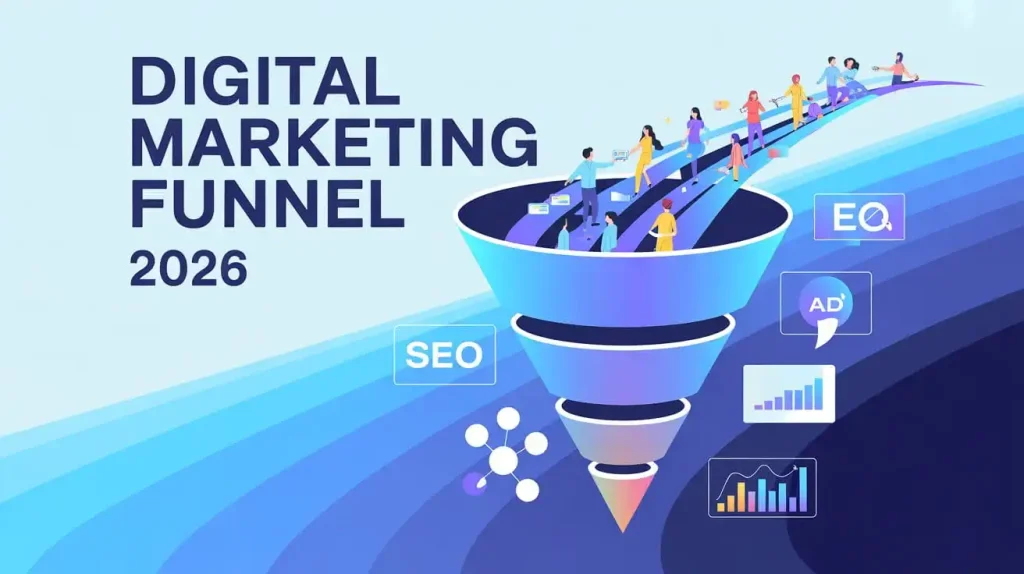
A digital marketing funnel is the structured journey that guides a user from discovering your business to becoming a customer.
It helps you understand:
- What the user wants at each stage
- What type of content they need
- What action they are likely to take
Instead of treating all users the same, a funnel allows you to move them step by step toward conversion.
For a broader understanding, read digital marketing guide.
How a Funnel Actually Works (Real System)
A funnel is not just a linear process. It is a behavior-based system.
A user may:
- Enter from a blog post
- Leave and come back later
- Visit multiple pages
- Convert after several interactions
Your job is to make this journey smooth and logical.
Core Stages of a Digital Marketing Funnel
Funnel Overview
| Stage | User Intent | Your Objective |
| Awareness | Learning | Attract attention |
| Consideration | Evaluating | Build trust |
| Decision | Comparing | Remove doubts |
| Action | Ready to act | Convert |
Each stage requires different messaging and content.
Stage 1: Awareness (Traffic Generation)
At this stage, users are searching for information.
They are not ready to buy.
What You Should Do
- Create informative blog posts
- Focus on SEO
- Answer user questions
This is where most traffic comes from.
How AI Helps in Awareness Stage
AI can significantly improve your content strategy here.
Practical uses:
- Generate topic ideas based on search intent
- Identify keyword gaps
- Analyze competitor content
- Suggest content structure
For example, AI tools can show you what users are searching for and what type of content ranks.
But remember: AI gives direction, not final content. You still need to add real insights.
Stage 2: Consideration (Trust Building)
Now the user knows about your business and is evaluating options.
This is where trust matters.
What Works Here
- In-depth guides
- Comparison articles
- Case studies
How AI Helps in Consideration Stage
AI can help you understand user behavior and improve content quality.
Use cases:
- Analyze which content users spend more time on
- Identify drop-off points
- Suggest improvements in readability
You can also use AI to personalize content recommendations based on user behavior.
Stage 3: Decision (Conversion Preparation)
At this stage, the user is close to taking action but may have doubts.
What You Should Focus On
- Clear value proposition
- Testimonials
- Transparent pricing
- Strong call-to-action
How AI Helps in Decision Stage
AI is very powerful at this stage.
Practical applications:
- Predict which users are more likely to convert
- Personalize offers
- Optimize landing pages
For example, AI can show different content to different users based on their behavior.
Stage 4: Action (Conversion)
This is where the user takes the final step.
- Submits a form
- Makes a purchase
- Contacts you
Your goal is to make this process simple and frictionless.
How AI Helps in Action Stage
AI improves conversion by reducing friction.
Examples:
- Smart chatbots to answer queries instantly
- Auto-filled forms
- Personalized CTAs
These small improvements can significantly increase conversions.
Real Example of a Funnel (With AI Integration)
| Stage | Without AI | With AI |
| Awareness | Generic blog content | Data-driven content |
| Consideration | Static content | Personalized content |
| Decision | Same offer for all | Behavior-based offers |
| Action | Manual process | Automated assistance |
This shows how AI improves efficiency at every stage.
Common Funnel Mistakes
Most businesses struggle because of these issues:
- Focusing only on traffic
- No clear next step
- Weak internal linking
- Ignoring user behavior
- No optimization
These mistakes reduce conversion rates.
How to Build a High-Converting Funnel
A strong funnel requires structure.
Step-by-Step Process
- Understand your audience
- Map their journey
- Create stage-specific content
- Connect pages using internal links
- Optimize continuously
Role of Content in a Funnel
Content is what moves users through the funnel.
- Awareness → Blog posts
- Consideration → Guides
- Decision → Service pages
- Action → Landing pages
Without proper content, the funnel breaks.
Learn more: digital marketing strategist.
Funnel Optimization (Advanced Strategy)
Once your funnel is live, optimization becomes critical.
Key Areas to Improve
| Area | Focus |
| Traffic | SEO improvement |
| Engagement | Better content |
| Conversion | Strong CTAs |
| Retention | Email follow-ups |
Even small improvements can increase overall results.
Tracking Funnel Performance
You cannot improve what you do not measure.
Track:
- User flow
- Drop-off points
- Conversion rates
This is where digital marketing analytics.
Future of Funnels (AI-Driven Systems)
Funnels are becoming smarter.
Instead of static journeys, we now have dynamic funnels where:
- Content adapts to user behavior
- Offers change based on intent
- Decisions are data-driven
AI is making funnels more personalized and efficient.
Conclusion
A digital marketing funnel is essential for converting traffic into customers.
Without it, even high traffic does not produce results.
When you combine a structured funnel with AI-driven optimization, you create a system that is both scalable and efficient.
Faq’s
1. What is a digital marketing funnel?
A digital marketing funnel is a process that guides users from awareness to conversion and retention.
2. What are the stages of a marketing funnel?
Awareness, consideration, conversion, and retention.
3. Why is a funnel important in digital marketing?
It helps improve conversions and understand customer behavior.
4. What is TOFU, MOFU, and BOFU?
Top, middle, and bottom stages of the funnel.
5. How do you create a digital marketing funnel?
By understanding your audience and creating content for each stage.
6. What tools are used in funnels?
Analytics tools, email platforms, CRM systems, and ad platforms.