
Digital marketing has changed significantly over the past few years. What used to work earlier — basic SEO, random posting, or running ads without structure — no longer delivers consistent results.
Today, successful businesses treat digital marketing as a system, not a set of isolated tactics.
At the same time, artificial intelligence has started playing a major role. It is not replacing marketers, but it is changing how efficiently marketing is executed.
This guide is designed to give you a clear, practical understanding of digital marketing — how it works, what actually matters, and how AI is shaping its future.
Table of Contents
What is Digital Marketing
Digital marketing is the process of attracting, engaging, and converting customers through online channels.
But in practical terms, it is better understood as a structured system that connects three things:
- Visibility (how people find you)
- Trust (why they believe you)
- Conversion (why they take action)
If any of these is missing, your marketing will not work effectively.
How Digital Marketing Works (Real System)
Most beginners focus only on traffic. That is only one part of the process.
A working system looks like this:
- A user discovers your business
- They interact with your content
- They evaluate your offer
- They take action
- You analyze and improve
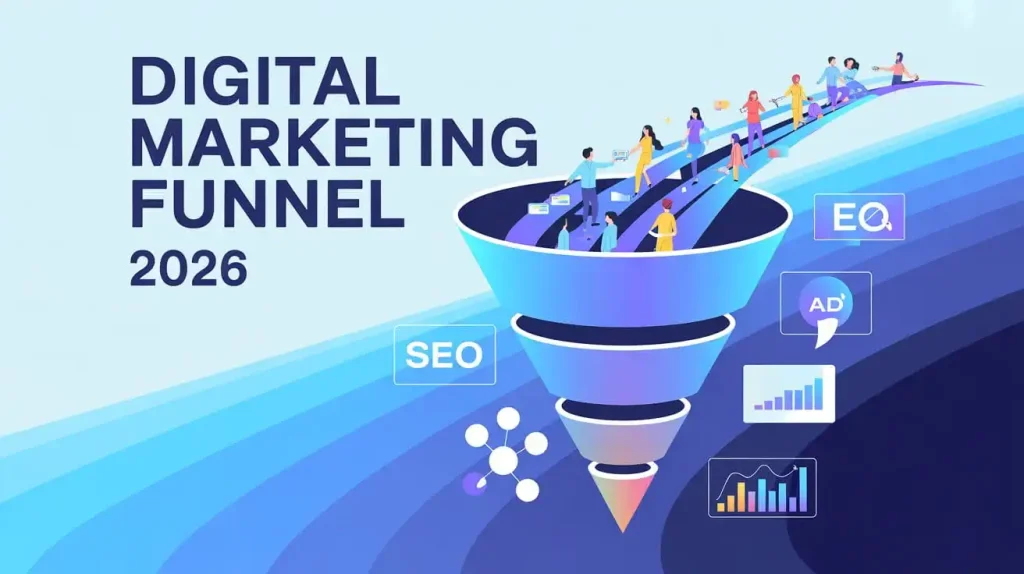
This process is known as a funnel.
To understand this deeply, read digital marketing funnel.
Digital Marketing Funnel (Where Most Businesses Struggle)
A funnel represents the journey from visitor to customer.
The mistake most businesses make is focusing only on the first stage — bringing visitors — while ignoring what happens after that.
Funnel Stages
| Stage | Purpose |
| Awareness | Getting attention |
| Consideration | Building trust |
| Decision | Helping user choose |
| Action | Conversion |
If your funnel is weak, increasing traffic will not improve results.
Role of a Digital Marketing Strategist
Execution without strategy leads to inconsistent outcomes.
A strategist ensures that every effort is aligned with a goal.
They define:
- Target audience
- Content direction
- Channel selection
- Optimization approach
Without strategy, marketing becomes random and difficult to scale.
Learn more: digital marketing strategist.
Digital Marketing Channels That Actually Work
There are many channels available, but not all of them are equally effective.
Search engine optimization helps in building long-term traffic. Paid ads provide quick visibility. Content marketing builds authority over time. Email marketing helps retain users. Social media works well for engagement.
The key is to choose channels based on your business goals, not trends.
Digital Marketing Analytics (Where Real Growth Happens)
Many businesses create content but never analyze performance.
This is one of the biggest reasons for slow growth.
Key Metrics to Track
| Metric | Importance |
| Traffic | Measures reach |
| Bounce Rate | Indicates relevance |
| Conversion Rate | Shows effectiveness |
| User Behavior | Helps improve experience |
When you understand these metrics, you can make informed decisions instead of guessing.
Learn more: digital marketing analytics.
Digital Marketing Audit (Improvement System)
An audit helps you identify what is working and what is not.
Instead of making random changes, you analyze your system and improve it step by step.
You should audit:
- Website structure
- SEO performance
- Content quality
- Conversion paths
Step-by-step guide: digital marketing audit.
How AI is Transforming Digital Marketing
Artificial intelligence is not a shortcut to success, but it is a powerful tool when used correctly.
Most people either ignore AI or depend on it completely. Both approaches are wrong.
The right approach is to use AI as a support system, not a replacement for thinking.
Where AI Helps in Digital Marketing
| Area | How AI Helps |
| Content Research | Finds topics and gaps |
| Content Creation | Speeds up writing |
| SEO Optimization | Suggests keywords and structure |
| Data Analysis | Identifies patterns |
| Personalization | Improves user experience |
Practical Use of AI (Real Examples)
AI can help you save time and improve efficiency, but only if you use it properly.
For example:
- You can use AI to generate content ideas, but you should add your own insights
- You can use AI to analyze data, but you should decide the strategy
- You can use AI to optimize headlines, but you should understand your audience
The biggest mistake is publishing raw AI content without editing. That leads to low-quality output.
Digital Marketing Packages (What to Understand Before Buying)
Many businesses invest in packages without understanding what they include.
This often leads to poor results.
Before choosing a package:
- Check what services are included
- Understand expected outcomes
- Avoid generic solutions
Detailed breakdown: digital marketing packages.
Common Digital Marketing Mistakes
After analyzing multiple websites, some common mistakes appear:
- No clear structure
- Weak internal linking
- Ignoring user intent
- Publishing inconsistent content
- Not tracking performance
Fixing these issues can significantly improve results.
What Works in Digital Marketing Today
Digital marketing has evolved. Basic techniques are no longer enough.
Today, success depends on:
- Understanding search intent
- Creating helpful content
- Building topical authority
- Connecting content through internal links
- Maintaining consistency
If your content genuinely helps users, it has a much higher chance of ranking.
When to Use Digital Marketing Services
You should consider professional services if:
- You do not have time to execute
- You lack expertise
- You want faster results
Explore options: digital marketing services for small business.
Future of Digital Marketing
The future of digital marketing is closely linked with AI and data.
We are moving towards:
- More personalized experiences
- Better intent understanding
- Faster content production
- Smarter decision-making
However, one thing remains constant:
Structured and helpful content always performs better.
Conclusion
Digital marketing is not about doing everything. It is about doing the right things in the right way.
If you build a system that connects traffic, content, and conversion — and use AI as a support tool — you can achieve consistent growth.
FAQs
1. What is digital marketing in simple terms?
Digital marketing is promoting products or services online using platforms like Google, social media, and email.
2. What are the types of digital marketing?
SEO, content marketing, social media marketing, PPC, and email marketing.
3. Is digital marketing a good career?
Yes, it is one of the fastest-growing and highest-demand careers worldwide.
4. How long does SEO take?
SEO usually takes 3–6 months to show results.
5. What skills are needed for digital marketing?
SEO, content writing, analytics, social media, and strategy.
6. Can I start digital marketing without experience?
Yes, beginners can start with basic SEO and content creation.
7. What is the difference between SEO and PPC?
SEO is organic, while PPC is paid advertising.
8. Why is digital marketing important?
It helps businesses reach targeted audiences and grow online.
9. What is the future of digital marketing?
AI-driven, user-focused, and data-based strategies.
10. Is digital marketing easy to learn?
It is beginner-friendly but requires continuous learning and practice.