
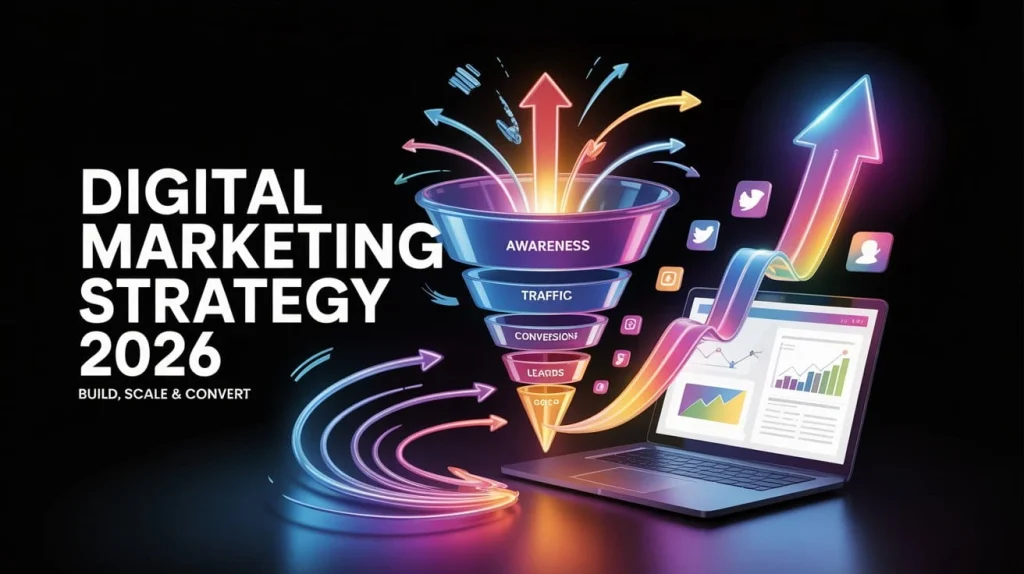
A digital marketing strategy is an organized plan that outlines how a company uses data, content, and online platforms to achieve specific marketing objectives, such as traffic, leads, and sales.
Despite being engaged online, many businesses still struggle to expand. They run advertisements, publish information, and maintain consistency, yet the outcomes are still uncertain.
Effort is not the issue. It is the lack of a well-defined plan.
A digital marketing strategy unifies all of your efforts into one cohesive framework. It guarantees that every action you take is in line with your objectives, target audience, and quantifiable results.
Marketing becomes haphazard without a plan. It becomes scalable with a strategy.
Understanding the entire ecosystem through a Digital Marketing Guide, which describes how various channels interact, is helpful if you are starting from scratch.
Table of Contents
The Significance of Digital Marketing Strategy in 2026
Isolated strategies are no longer the focus of digital marketing. It has to do with systems.
These days, search engines give priority to:
- The user’s intention
- Quality of content
- Knowledge and confidence
- Uniformity across channels
You can adjust to these changes with the aid of a clear approach.
Direction and Clarity
You are aware of what needs to be done, why, and how to gauge your progress.
Increased ROI
You concentrate on what produces results rather than dispersing your efforts across several channels.
Regular Growth
Instead of short-term spikes, a strategy guarantees long-term performance.
Better Decision-Making
Instead of making assumptions, you rely on data.
Core Components of a Digital Marketing Strategy
A solid plan is composed of several interrelated components.
1. Establishing objectives and business alignment
Every plan begins with specific goals.
Typical objectives consist of:
- Increasing the number of visitors to websites
- Producing leads
- Increasing conversions
- Developing the authority of your brand
Your marketing objectives should be in line with business results.
2. Targeting and Researching Audiences
It’s essential to comprehend your audience.
You must determine:
- Who your ideal customer is
- What problems are they trying to solve
- How do they search for solutions
This helps you create content that matches real user intent.
3. Content Strategy (Growth Foundation)
Trust and visibility are fueled by content.
An effective content strategy emphasizes:
- Resolving user issues
- Covering topics in depth
- Providing clear and practical information
Search engines now reward content that demonstrates real understanding.
4. Choosing a Channel
Not every firm can benefit equally from every channel.
Typical channels consist of:
- Search engines (SEO)
- Social media
- Sponsored advertising
- Email advertising
The channels where your audience is most active should be the main focus of your plan.
5. Planning Using Funnels
Campaigns and content should be mapped across the consumer journey in a strategy.
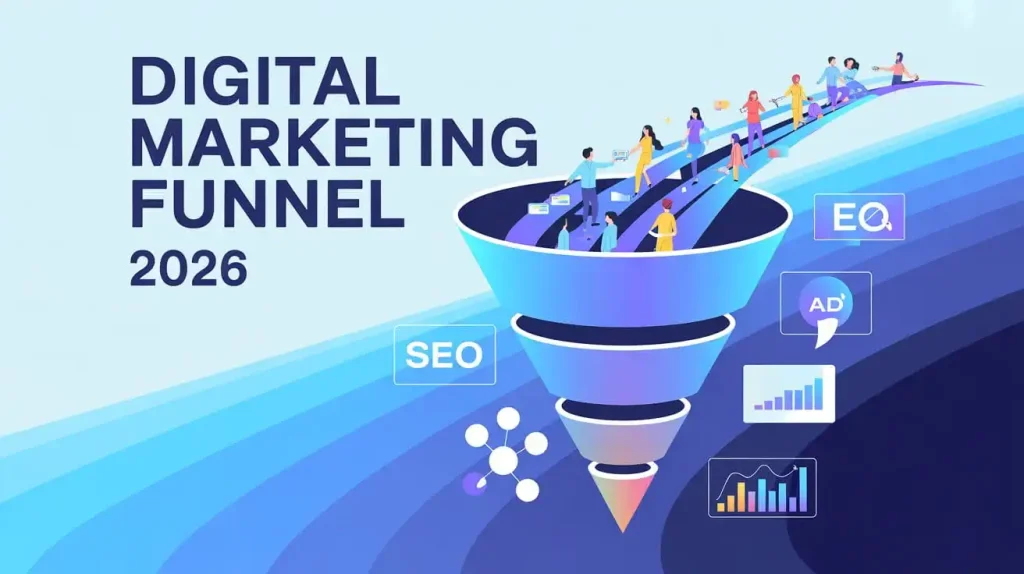
Understanding the Digital Marketing Funnel, which describes how users progress from awareness to conversion, makes this more apparent.
6. Integration of Data and Analytics
Strategy is reduced to conjecture in the absence of data.
You ought to monitor:
- sources of traffic
- User actions
- Rates of conversion
For further in-depth information, see Digital Marketing Analytics, which provides a thorough explanation of performance measurement.
Detailed Framework for Digital Marketing Strategies
Step 1: Establish Specific Goals
Establish clear objectives first.
For instance:
- 40% more organic traffic
- Produce 100 qualifying leads every month.
Step 2: Recognize Your Audience
Use the following to conduct research:
- Search terms
- Client comments
- Analysis of competitors
Step 3: Examine Rivals
Examine what rivals are doing.
Determine
- Their best-performing material
- Strategy for keywords
- Gaps in content
Finding opportunities is aided by this.
Step 4: Create a Content Strategy
Create a system of organized content.
Add:
- Pillar pages
- Articles that support clusters
- Internal connections
Both SEO and user experience are enhanced by this.
Step 5: Select Channels of Distribution
Choose a strategy for promoting your content.
Among the options are:
- Natural search
- Social media
- Campaigns via email
- Paid advertisements
Step 6: Conversion Optimization
Traffic is insufficient on its own.
You must:
- Include obvious cues to action
- Enhance landing pages
- Make user journeys simpler
Step 7: Assess and Enhance
Regularly monitor performance.
Modify your approach in light of:
- Data insights
- User actions
- Trends in conversion
Digital Marketing Strategy Types
SEO Approach
Focuses on long-term organic growth via optimization and content.
Strategy for Content Marketing
Focuses on producing worthwhile material to draw in and keep users.
Strategy for Paid Marketing
Uses advertising to produce outcomes quickly.
Social Media Approach
Increases engagement and brand visibility.
Strategy for Email Marketing
Emphasizes connection development and retention.
Typical Errors in Digital Marketing Planning
Absence of Specific Objectives
You can’t gauge success without goals.
Ignoring User Intent
Content that does not match intent will not perform.
Excessive Dependency on a Single Channel
Diversification is crucial.
Absence of Conversion Focus
Traffic has little value if it doesn’t convert.
Unreliable Performance
The secret to long-term growth is consistency.
AI’s Place in Digital Marketing Strategy (2026)
AI is revolutionizing the development and implementation of strategies.
Where AI Is Useful
- Analysis of data
- Planning content
- Customization
- Optimization of campaigns
Where Humans Are Crucial
- Development of strategies
- Originality
- Making decisions
AI should support your strategy, not replace it.
Actual Example
A company consistently publishes material, but it doesn’t grow.
Following the development of a plan:
- The content matches the purpose of the search.
- Improvements in internal connections
- The funnel is optimized.
Outcome:
Conversions and traffic are rising steadily.
Digital Marketing Strategy’s Future
Strategies for digital marketing are changing.
Important Trends
- Planning with AI assistance
- SEO with a purpose
- Individualized encounters
- Data-driven choices
Companies will remain competitive if they adjust to these trends.
In conclusion
Successful online growth is built on a digital marketing plan.
It links your efforts, synchronizes your objectives, and guarantees that each activity leads to quantifiable outcomes.
Marketing is inconsistent in the absence of a strategy. It becomes an organized system with a strategy that promotes long-term success.
Faq’s
What is a digital marketing strategy?
A digital marketing strategy is a plan that outlines how a business uses digital channels to achieve marketing goals.
Why is a digital marketing strategy important?
It provides direction, improves ROI, and ensures consistent growth.
What are the key components of a strategy?
Goals, audience research, content, channels, analytics, and optimization.
How do you create a digital marketing strategy?
Define goals, understand your audience, create content, choose channels, and track performance.
What is the biggest mistake in digital marketing strategy?
Lack of clear direction and ignoring user intent.